
Effects of antifungal drugs and delivery vehicles on morphology and proliferation of equine corneal keratocytes in vitro
Rachel L. Davis1,2 | Adrian J Reber2 | David J Hurley2 | Ursula M Dietrich2
Abstract
Objective
To evaluate the effects of topical antifungal drugs and delivery vehicles on the morphology and proliferation rate of cultured equine keratocytes.
Study population
16 corneas obtained from 8 apparently ophthalmologically normal horses < 0.5 hours after euthanasia for reasons unrelated to the study.
Procedures
Primary cultures of equine keratocytes were obtained from corneal stroma and were exposed to several concentrations of 3 commonly used, topically applied antifungals: natamycin, itraconazole, and miconazole. In addition, effects of drug delivery vehicles DMSO, benzalkonium chloride, and carboxymethylcellulose and a combination vehicle composed of polyethylene glycol, methylparaben, and propylparaben were also evaluated. Morphological changes and cellular proliferation were assessed 24, 48, and 72 hours after application.
Results
At the highest concentrations tested, all antifungals caused marked cellular morphological changes and inhibited proliferation. At low concentrations, natamycin and miconazole induced rounding, shrinking, and detaching of the cells with inhibition of cellular proliferation. Natamycin caused the most severe cellular changes. Itraconazole, at the low concentrations, caused minimal morphological changes and had a minimal effect on proliferation. All vehicles tested had significantly less effects on cellular morphology and proliferation when compared with the antifungals, except for the combination vehicle, which caused severe morphological changes and inhibited proliferation, even at low concentrations. The DMSO had minimal effects on cellular morphology and proliferation, even at high concentrations.
Conclusions and clinical relevance
Itraconazole had significantly less cytotoxic effects on equine keratocytes in culture than did natamycin or miconazole. Natamycin had severe cytotoxic effects in vitro.
Images
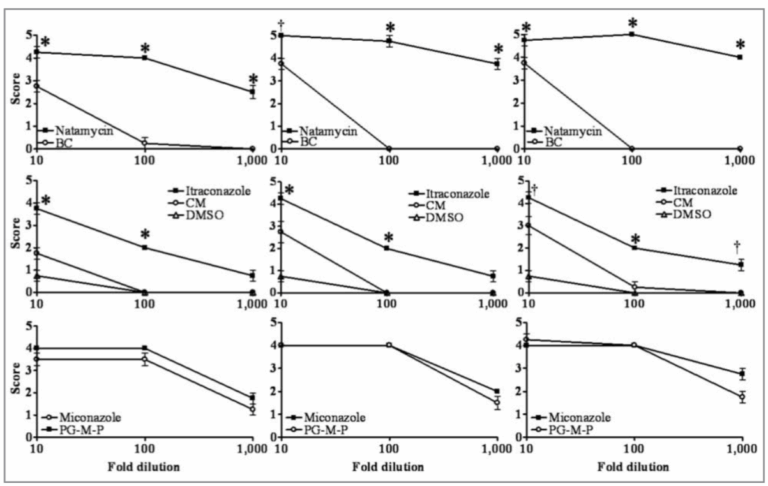
Figure 1— Mean ± SEM morphological scores for equine keratocytes exposed to natamycin, itraconazole, and miconazole (original concentrations: 50,000, 10,000, and 10,000 μg/mL, respectively) in their respective vehicles (BC, CM and DMSO, and PG-M-P, respectively) or to their vehicles alone at clinically relevant concentrations, adjusting for tear film dilution. Morphological changes were scored on a 5-point scale (0 = no evidence of any morphological changes, no cell detachment from the plate, and normal cell adherence and appearance in culture; 5 = 100% detachment from plate, no recognizable keratocytes in culture, loss of cells, and severe shrinking and rounding) for each dilution at 24 (left column), 48 (middle column), and 72 (right column) hours after treatment application. *†Values differ significantly (*P < 0.001, †P < 0.01) between the antifungal and its vehicle or vehicles at the indicated dilution.
Keywords: equine keratocytes, topical antifungal drugs, natamycin cytotoxicity, itraconazole safety, miconazole effects, equine corneal cells, antifungal cytotoxicity, keratocyte morphology, keratocyte proliferation, antifungal drug vehicles, DMSO effects, benzalkonium chloride, carboxymethylcellulose, equine ophthalmology, fungal keratitis treatment
1Animal Eye Clinic, Westfield, Indiana, USA
2Department of Small Animal Medicine and Surgery, College of Veterinary Medicine, University of Georgia, Athens, GA 30602, USA
Correspondence:
Rachel L. Davis, DVM, MS, Diplomate, ACVO – Ophthalmologist
Animal Eye Clinic
4750 Killarney Drive
Carmel, IN 46033
Email: info@indyaec.com